AgMIP-Wheat
Main Contacts for Initiative
Senthold Asseng, Pierre Martre, Heidi Webber & Frank Ewert
Linked with the program on Wheat Plant and Crop Modelling of the international Wheat Initiative.
Brief Description of Activity
AgMIP-Wheat started in 2010 and aims to improve, expand and apply wheat crop models in climate change impact and adaptation assessments by bringing together crop modelers, experimentalists, plant breeders, biostatisticians and climate scientists working with field measurements and future scenarios. We explore applications for point simulations for upscaling and compare methods for impact assessments.
List of Participating Models (alphabetical)
- AFRCWHEAT2, request from jrp@plen.ku.dk
- AQUACROP
- APSIM-Next Generation
- APSIM-Wheat
- CropSyst
- DAISY
- DSSAT-CERES
- DSSAT-CROPSIM
- DSSAT-NWheat
- EPIC-Wheat
- Expert-N – CERES
- Expert-N – GECROS
- Expert-N – SPASS
- Expert-N – SUCROS
- GLAM
- HERMES
- LINTUL
- LPJmL
- MCWLA-Wheat, request from taofl@igsnrr.ac.cn
- MONICA
- OLEARY, request from gjoleary@yahoo.com
- pyGECROS
- SALUS
- SIMPLACE
- SIRIUS
- SiriusQuality
- SSM-Wheat, request from bindi@unifi.it
- STICS
- WHEATGROW, request from yanzhu@njau.edu.cn
- WOFOST
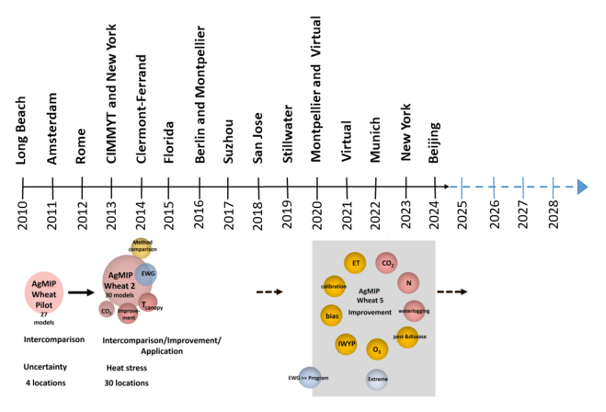
Figure 1: Meetings times, location and start of new activities of AgMIP-Wheat. The idea of the AgMIP-Wheat team was conceived in November 2010 at the first Global AgMIP Workshop at Long Beach in California. The AgMIP Wheat Team is organised since 2020 in several specific activities (see table below) with focus on model improvement. AgMIP-Wheat meets regularly to discuss progress, to explore new ideas and to decide on new research agendas.
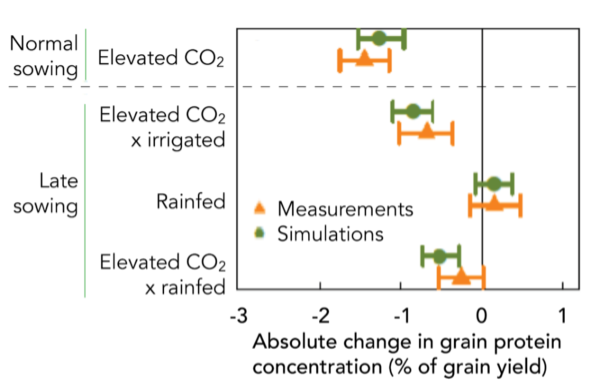
Figure 2: Measured (orange) and multi-model ensemble simulated (green) wheat grain protein concentration under different climatic (dry/wet and moderate/hot) and elevated CO2 conditions. After Asseng et al. (2019). Error bars show 1 s.e. of measured and simulated mean.
AgMIP-Wheat Activities and Contacts
|
Traits |
Pierre Martre, Senthold Asseng, Heidi Webber & Frank Ewert AgMIP-Wheat Traits combines field experiments and crop physiology to quantify the impact of traits, the size of a trait change, and trait combinations on wheat grain yield potential. Simulated trait impact scenarios are created to guide breeding towards the most effective traits and trait combinations for future climate scenarios and wheat across the world. This research has been supported by the International Wheat Yield Partnership (IWYP, grant No. IWYP115). |
|
Ozone
|
|
|
Waterlogging |
Taru Palosuo, Margarita García-Vila, Matthew Harrison, Ke Liu, Rogério de Souza Nóia Júnior, Murilo Vianna, Tobias Weber & Jin Zhao AgMIP-Wheat Waterlogging tests with field observations, develops and improves model routines to simulate transient waterlogging and to explore the impact of climate change, particularly of increased rainfall intensity, on crop growth and yield. |
|
Nitrogen |
AgMIP-Wheat Nitrogen tests with field observations, develops and improves model routines to simulate crop and soil nitrogen dynamics to explore the impact of climate change on crop nitrogen use, nitrogen losses and crop yield. |
|
Evapotranspiration |
AgMIP-Wheat Evapotranspiration tests models with field observations and improves model routines related to evapotranspiration in wheat models to explore the impact of climate change on crop water use. |
|
Calibration |
|
|
CO2 |
AgMIP-Wheat CO2 tests models with field observations (FACE experiments) and improves model routines related to cultivar specific response to elevated atmospheric CO2 concentrations and its impact on crop growth and yield under future climate change scenarios. |
|
Pest and Diseases |
AgMIP-Wheat Pest and Diseases develops and tests with field observations model routines related to pest and disease impact in wheat models, considering major diseases such as leaf rust, yellow rust, Septoria tritici blotch, and powdery mildew to explore the interplay of climate change scenarios, crop management, and crop protection strategies on disease dynamics and crop performance, to provide insights for designing sustainable cropping systems that explicitly account for the impact of plant diseases under future climatic conditions. |
|
Bias and Correction |
AgMIP-Wheat Bias and Correction evaluates whether multivariate bias adjustment of cross-correlated climate variables improves crop model performance compared to univariate adjustments using bias adjustment methods applied to several variables across locations, compared to AgMERRA re-analysis as a reference. |
New Planned AgMIP-Wheat Activities
|
Crop and biodiversity (not started yet) |
Current contact: Senthold Asseng |
|
Risk of yield and leaching |
|
|
Sink source relationship |
Carolina Rivera-Amado, Senthold Asseng, Pierre Martre, Enli Wang |
Overview of Participants
- ~30 wheat crop modeling groups from 15 countries
- Field experimentalists and breeders from CIMMYT Mexico, Universidad Austral, Chile, University of Buenos Aires, Argentina, INRAE, France, ARVALIS, France, Crop and Food New Zealand and CSIRO Australia
- A biostatistician and climate scientists.
Current Research Focus
- Model improvement across several activities on evapotranspiration, canopy temperature, CO2, N supply, ozone, calibration, extreme events and waterlogging following the AgMIP-Wheat approach outlined by Wang and Martre et al. (2017).
- exploring new activities on model improvement, risk assessment, source-sink relationship and considering disease interactions and biodiversity.
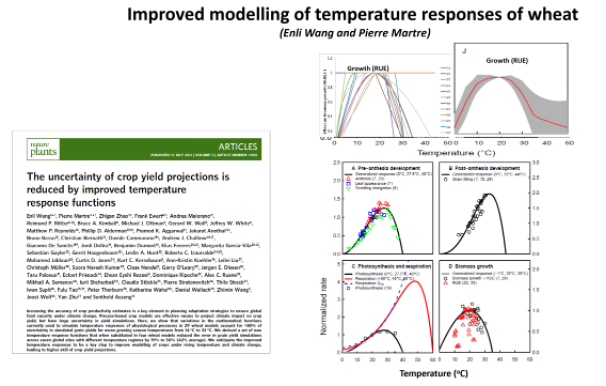
Figure 3: Cover page of Nature Plants publication on model improvement from AgMIP-Wheat. Temperature functions in models and derived from experiments after Wang and Martre et al. (2017).
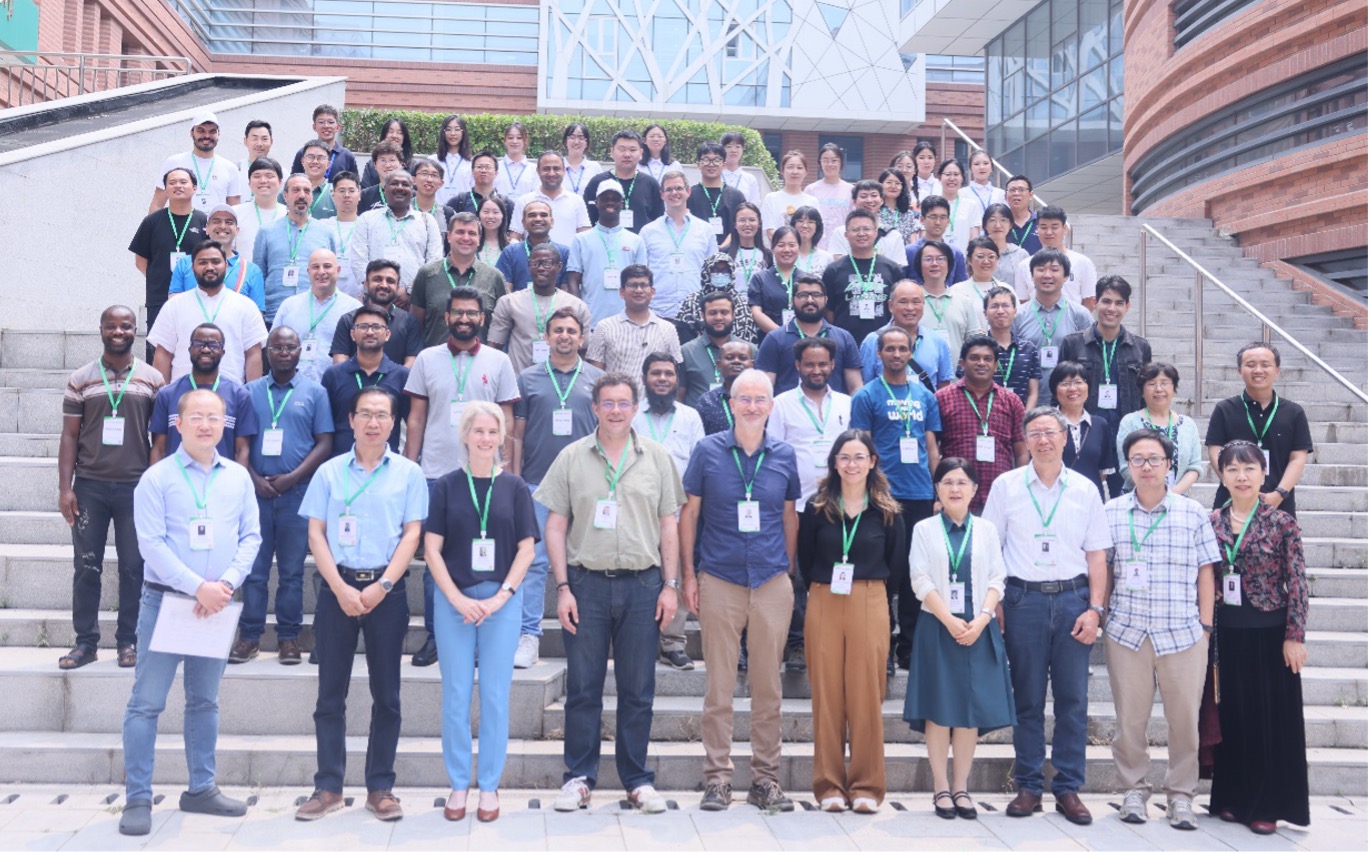
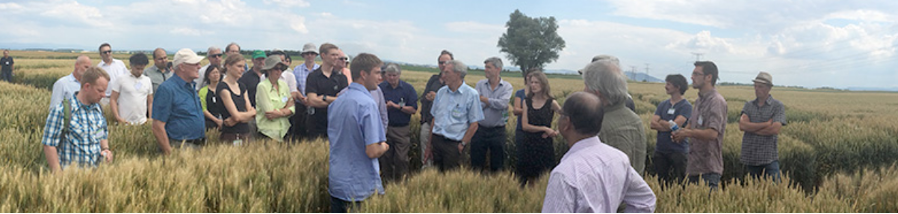
Figure 4: AgMIP-Wheat workshop, Beijing, China, July 2024.
References
Recent Noteworthy Finding: “New wheat varieties can contribute to food security”
Martre et al., 2024. “Global needs for nitrogen fertilizer to improve wheat yield under climate change.” NATURE PLANTS 10. https://doi.org/10.1038/s41477-024-01739-3.
Wheat is the world’s most important grain. But it has high environmental costs due to the need to fertilize with nitrogen. The AgMIP-Wheat Team has now determined that new wheat varieties produce better crops with the same quantities of fertilizer. It is not always easy to find the right amount of fertilizer for wheat crops. If too little is applied, it is completely used up, but the harvest falls short of its full potential. And if too much is used, the harvest is good but the growing grain does not consume all of the fertilizer. The surplus nitrogen finds its way into the environment and damages ecosystems and the climate. But wheat is essential for satisfying the growing hunger in the world.
To overcome these challenges, we have investigated new wheat cultivars still in the experimental stages. Their results have been published in Nature Plants. The team used data from five experimental fields representing global wheat producing regions with particularly high yields. The fields were included into a simulation model with other fields and analyzed under three climate scenarios: the climate conditions of today and global warming of 1 degree Celsius and 4.8 degrees Celsius. The results show the yields that can be expected from the tested varieties when different quantities of nitrogen fertilizer are applied.
The research showed that the new wheat cultivars achieve 16 % higher yields under current climate conditions than those now used if the same quantities of fertilizer are applied. Through improved utilization of the nitrogen, i.e. greater nitrogen efficiency, the ecological footprint is reduced. However, the team also showed that overall nitrogen needs will increase in the course of global warming if the full yield potential of the plants is to be achieved – although the new cultivars will still use nitrogen more efficiently than current varieties.
We recommend the continued use of the cultivars tested in the model in breeding programs. With improved selective breeding we can close the food gap for the next 20 to 30 years. But new varieties alone will not be sufficient to reconcile the conflicting goals of global food security, environmental protection and cost-effectiveness. What we need is a systemic approach that takes into account agricultural science methods, environmental aspects, socio-economic factors and policy makers.