
AgMIP-East Asia and AgMIP-Rice Joint International Symposium Held in Beijing October 24-26, 2026
5 November, 2026
The Agricultural Model Intercomparison and Improvement Project (AgMIP) East Asia International Workshop was successfully held at the Institute of Geographic Sciences and Natural Resources Research, Chinese Academy of Sciences, from October 24-26, 2026. The workshop was jointly organized by the AgMIP East Asia Regional Team (AgMIP-East Asia) and the AgMIP Rice Team (AgMIP-Rice), under the theme “Agricultural Models and Artificial Intelligence Empowering Smart Agriculture.” It attracted nearly 100 experts, scholars, and young researchers from China, the United States, France, Japan, the Republic of Korea, the Philippines, and other countries. Participants came from the Japan International Research Center for Agricultural Sciences (JIRCAS), the National Agriculture and Food Research Organization (NARO) of Japan, Seoul National University of the Republic of Korea, the French National Research Institute for Agriculture, Food and Environment (INRAE), Oregon State University of the United States, the International Rice Research Institute (IRRI), the International Maize and Wheat Improvement Center (CIMMYT), as well as domestic and international universities and research institutions including the Chinese Academy of Sciences, China Agricultural University, the Chinese Academy of Agricultural Sciences, the Chinese Academy of Meteorological Sciences, Peking University, and Beijing Normal University. On October 25 and 26, the workshop held two days of academic presentations and exchanges.
Professor Fulu Tao of the Institute of Geographic Sciences and Natural Resources Research, Chinese Academy of Sciences, Chair of the conference, first delivered opening remarks. He warmly welcomed experts and peers from home and abroad to discuss the innovation and application of agricultural models, and emphasized the challenges facing agricultural production systems against the background of global change and the importance of agricultural models in developing smart agriculture. The conference invited some renowned experts in related fields to give academic presentations, with a total of 35 presentation, including 26 oral presentations and 9 posters. Latest research progress was reported and in-depth discussions were held around topics such as the impacts of extreme climate and compound disasters on agriculture, agricultural model intercomparison and improvement, integrated assessment of regional impacts of global change, agricultural big data, agricultural models, and artificial intelligence empowering smart agriculture, and agricultural adaptation, carbon sequestration and emission reduction, and climate-smart agriculture.
Finally, participating experts conducted in-depth exchanges on future research priorities, the feasibility and implementation pathways of international cooperation, and the prospects for deep integration of artificial intelligence and crop process models. They focused on the potential of coupling big data, artificial intelligence, and agricultural models to drive model innovation, improve predictive capability, and support intelligent agricultural decision-making, and exchanged views on strengthening international research cooperation, promoting data and model sharing, and advancing interdisciplinary research.
This conference was a high-level academic event. It not only showcased the latest advances in interdisciplinary research on agricultural information, models, and artificial intelligence, providing ideas for further deepening research, but also promoted in-depth exchanges among different countries, research institutions, and disciplines, offering new ideas and a cooperation platform for deepening domestic and international cooperation, advancing agricultural model innovation, and developing smart agriculture.
The full Symposium agenda is included below.
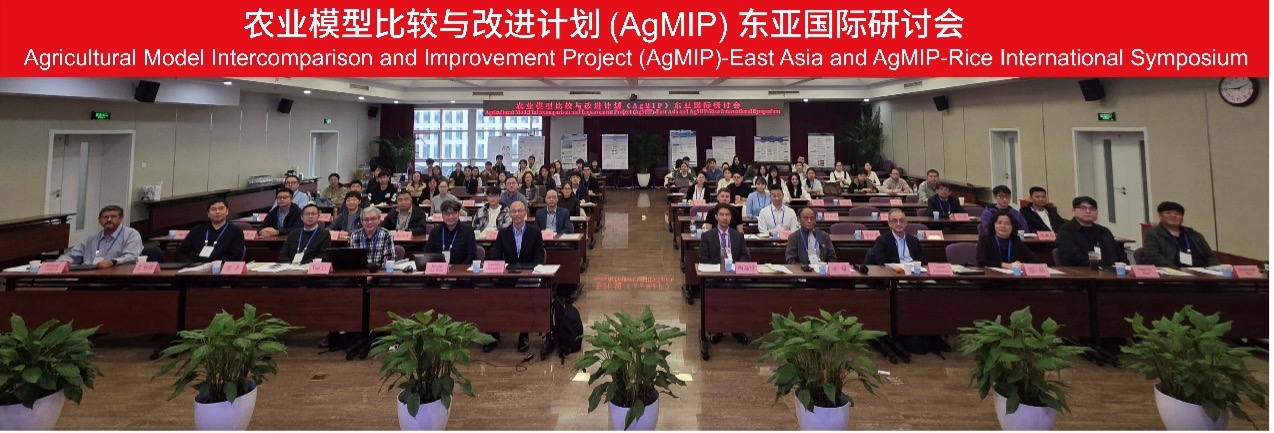
Participant group photo from the AgMIP-East Asia and AgMIP-Rice Joint International Symposium
Symposium Theme: Coupling Agricultural Models with Artificial Intelligence to Empower Smart Agriculture
Symposium Venue: Room C602, No. 11A, Datun Road, Chaoyang District, Beijing, China (Institute of Geographic Sciences and Natural Resources Research, Chinese Academy of Sciences)
Symposium Date: October 24-26, 2026
Agenda
| Time | Session/Presentation Title | Convener |
|
October 24, 2026 |
||
| 14:00 – 18:00 | Registration | |
|
October 25, 2026 |
||
| 9:00 – 9:15 | Opening Ceremony & Group Photo | Fulu Tao |
| 9:15 – 9:40 | AgMIP-Rice: New Research Directions and a Coordinated Multi-site Assessment of Adaptation-Mitigation Synergies in Rice Systems Toshihiro Hasegawa |
Fulu Tao |
| 9:40 – 10:05 | Modeling Rice Paddy Methane Emissions: From Regional to Global Yao Huang |
|
| 10:05 – 10:30 | Carbon-nitrogen cycles and climate change Baojing Gu |
|
| 10:30 – 10:40 | Tea Break | |
| 10:40 – 11:00 | Improving MCWLA Agroecosystem Model for Climate Smart Agriculture Fulu Tao |
Toshihiro Hasegawa |
| 11:00 – 11:20 | ORYZA: System Analysis Tool for Smart Rice Tao Li |
|
| 11:20 – 11:40 | Evidences and global modeling of extreme climate impacts on rice yield Feng Zhou |
|
| 11:40 – 12:00 | Refined crop modelling reveals aggravating extreme weather impacts on global wheat productivity and ceiling irrigation adaptation Zhao Zhang |
|
| 12:00 – 13:30 | Lunch | |
| 13:30 – 13:50 | Risk of extreme heat on crop yield Xuhui Wang |
Kwang Soo Kim |
| 13:50 – 14:10 | Data-based Crop Modeling To Accelerate Crop Breeding Under Climate Change Wei Xiong |
|
| 14:10 – 14:30 | How can data-driven models help improve the sustainability of rice production? David Makowski |
|
| 14:30 – 14:50 | Optimization of Alfalfa–Grain Crop Rotation Systems on the Loess Plateau Xingfa Lai |
|
| 14:50 – 15:10 | AI-Algorithmic Reconstruction of Cropland Ecological Process Models Puyu Feng |
|
| 15:10 – 15:30 | Research and Development Progress of the Global Gridded Crop Model GPAM and Its Application in the Land Surface Model CoLM2024 Fang Li |
|
| 15:30 – 15:50 | Tea Break | |
| 15:50 – 16:10 | Evaluating the STICS soil-crop model for grapevine across contrasted soils and cultivars: A 20-year local evaluation Martin Pardon |
Roberto Valdivia |
| 16:10 – 16:30 | Accelerating Scalable Plant Physiology Modeling through UFEED-Empowered Machine Learning Hongrui Wang |
|
| 16:30 – 16:50 | Spatially explicit temperature optima improve climate impact assessment of global crop productivity Han Wang |
|
| 16:50 – 17:10 | Construction of a Winter Wheat Frost Module and Disaster Loss Simulation Based on the China Agricultural Meteorological Model (CAMM) Yuanda Zhang |
|
| 17:10 – 17:30 | Mechanisms and Simulation of the Impact of Low-Temperature Cold Damage on Rice Yield Yanying Shi |
|
| 18:00 – 20:00 | Dinner | |
|
October 26, 2026 |
||
| 9:00 – 9:25 | AgMIP Integrated Assessments: Approach and case studies Roberto Valdivia |
Xuhui Wang |
| 9:25 – 9:50 | Projected Changes in Rice Yield and Adaptation Strategies in South Korea Kwang Soo Kim and Young Sang Joh |
|
| 9:50 – 10:15 | A systematic review and meta-analysis to quantify heat-tolerance ranks for grain appearance quality in paddy rice Hitomi Wakatsuki |
|
| 10:15 – 10:25 | Tea Break | |
| 10:25 – 10:45 | Projected Impacts of Climate Change on Rice Productivity in Japan and the Effects of Implementing Multiple Adaptation Measures Yasushi Ishigooka |
Tao Li |
| 10:45 – 11:05 | Assessing Water-Related Risks to Soybean in South Korea Yean-Uk Kim and Beomseok Seo |
|
| 11:05 – 11:25 | Research on Summer Maize Yield Forecasting Methods Integrating Crop Models and Machine Learning Algorithms Dianchen Han |
|
| 11:25 – 11:45 | Research, Development, and Operational Application of the China Agricultural Meteorological Model (CAMM) Peijuan Wang |
|
| 11:45 – 12:05 | Predicting the Extreme: Process-Based Improvements in Crop Modeling for Climate Resilience Jin Zhao |
|
| 12:05 – 13:30 | Lunch | |
| 13:30 – 14:20 | General Discussion & Summary | Fulu Tao |
| 14:20 – 15:00 | Poster Presentations & Group Discussion | |
Poster Presentations:
Linking Genotype to G×E×M: Gene-Based Crop Modelling for Climate-Resilient Wheat
Yibo Li
Towards field-level crop yield prediction: integrating chlorophyll-driven biomass estimation and dynamic harvest index
Hongwei Zeng
Potential Expansion Areas of Potato in China and Their Multiple Benefits
Yang Li
Global Agricultural Drought Risk and Crop Production Resilience under Climate Change
Shuyang Han
Stage-Specific Environmental Characterization and Decision-Support Methods for Intelligent Control in a Chinese Solar Greenhouse
Xingyun Zhou
A Bottom-Up Framework for Compound Agricultural Disaster Risk Assessment: From the Separation of Hazard–Exposure–Vulnerability to Agricultural Model Improvement
Ying Tao
Dynamic Crop Yield Prediction at an 8-Day Scale by Combining Sun-Induced Chlorophyll Fluorescence Indices and Subseasonal Climate Forecasts
Chenxi Lu
Identification and Mapping of Irrigation Methods in China at 1-km Resolution
Yiqing Liu
How Much Climate Risk Can Management Offset? Evidence from Rice in Southeast Asia and Maize in China
Dianpeng Chen
High-Temperature Stress during Rice Flowering: The Key Role of Accumulated Temperature and Coastal Adaptation
Manshan Yang